Plywood or MDF? Choosing boards for kitchens and wardrobes
The board inside a cabinet matters as much as the finish on its face. What plywood and MDF are, where each works well and the questions to ask before you approve a quotation.
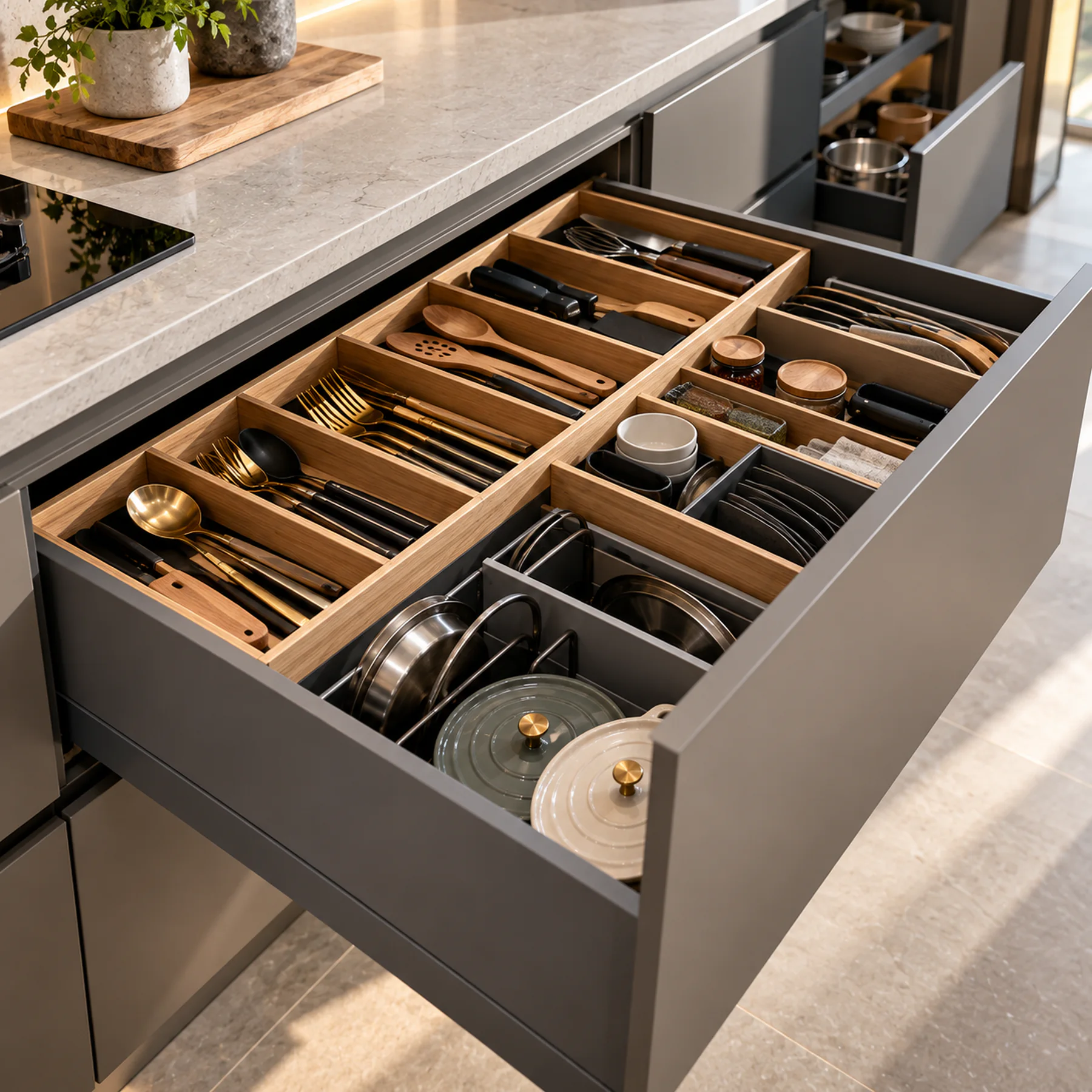
When you approve a kitchen or wardrobe, you mostly see the finish: the laminate, lacquer or veneer on the doors. Behind it is a board, and that board decides how the cabinet copes with moisture, weight and years of opening and closing. The two names you will hear most often are plywood and MDF.
The short answer: neither is "better" everywhere. Plywood is usually chosen for cabinet boxes (carcasses) and anywhere near water or heavy load. MDF is often chosen for doors and panels that need a very smooth, flat surface, especially for painted or lacquered finishes, as long as it is kept away from persistent moisture. Many good kitchens use both.
What they are
Plywood is made from thin layers of wood veneer glued together, with the grain of each layer turned against the one below. That cross-layering makes it strong for its weight and good at holding screws and hinges.
MDF (medium-density fibreboard) is made from fine wood fibres pressed together with resin into a dense, uniform sheet. It has no grain and no layers, so its surface and edges are very smooth and machine cleanly.
How they compare
| Plywood | MDF | |
|---|---|---|
| How it's made | Layers of veneer, cross-grained | Fine fibres pressed with resin |
| Surface | Can show grain or slight unevenness | Very smooth and flat |
| Holding screws and hinges | Generally strong | Weaker at edges; needs the right fixings |
| Weight | Lighter for its strength | Heavy |
| With moisture | Depends on the grade (see below) | Swells if water gets into raw edges |
| Typical use | Carcasses, sink units, shelves under load | Painted or lacquered doors, panels, mouldings |
Grades matter more than names
"Plywood" covers a wide range. In India, boards are commonly described by their intended use, for example moisture-resistant (MR) grades for dry interior areas and boiling-water-resistant (BWR/BWP) or marine grades where water is expected. MDF also comes in standard and moisture-resistant versions.
Ask which grade is proposed for each part of your kitchen, not just which board.
Where each one usually goes
- Sink unit and the cabinets around it: a water-resistant plywood grade, with sealed edges.
- Other kitchen carcasses: plywood is the common choice.
- Shutters with a painted or high-gloss lacquer finish: MDF, because its smooth surface takes the finish evenly.
- Wardrobe carcasses and shelves: plywood for strength over long spans.
- Decorative panels and profiles: MDF machines cleanly into shapes.
Common mistakes
- Using any board with exposed, unsealed edges near the sink.
- Comparing two quotations that both say "plywood" without checking the grade and thickness.
- Choosing a board for the doors without asking how the hinges will be fixed into it.
Questions to ask your designer
- Which board and grade is used for the carcass, the shutters and the sink unit?
- How are exposed edges sealed or edge-banded?
- How are hinges and channels fixed into each board?
- What finish goes on the inside of the cabinets?
In short
Ask for the board, the grade and the edge treatment for each part of the kitchen or wardrobe, written into the quotation. The right combination is usually plywood where strength and moisture matter, and MDF where a perfect painted surface matters. If you are planning a kitchen, start with our guide to modular kitchen layouts.
More finished rooms and work in progress on Instagram: @think__woodspace (opens in a new tab)